
ABOUT THE BOOK
PRACTICAL GUIDE TO EU AI ACT ARTICLE 50
Transparency Obligations for AI Systems
A practical guide for understanding AI transparency, building trust, reducing uncertainty, and turning responsible AI into organisational value.
WHY THIS BOOK EXISTS
Artificial intelligence is becoming part of everyday business, public services, education, healthcare, communication, media, and decision-making.
At the same time, organisations are facing a new challenge:
How do we use AI responsibly while remaining clear, compliant, practical, and understandable to the people affected by it?
Article 50 of the EU AI Act introduces important transparency obligations for AI systems and AI-generated or manipulated content.
But legal text alone does not automatically create understanding.
This book was created to make those obligations:
CLEAR
Understand what the rules mean.
PRACTICAL
See how they may apply in real situations.
STRUCTURED
Connect individual requirements to a complete organisational approach.
HUMAN-CENTRED
Understand what transparency means for the people interacting with AI.
ACTIONABLE
Turn regulatory understanding into practical decisions, processes, and safeguards.
ARTICLE 50 AT A GLANCE
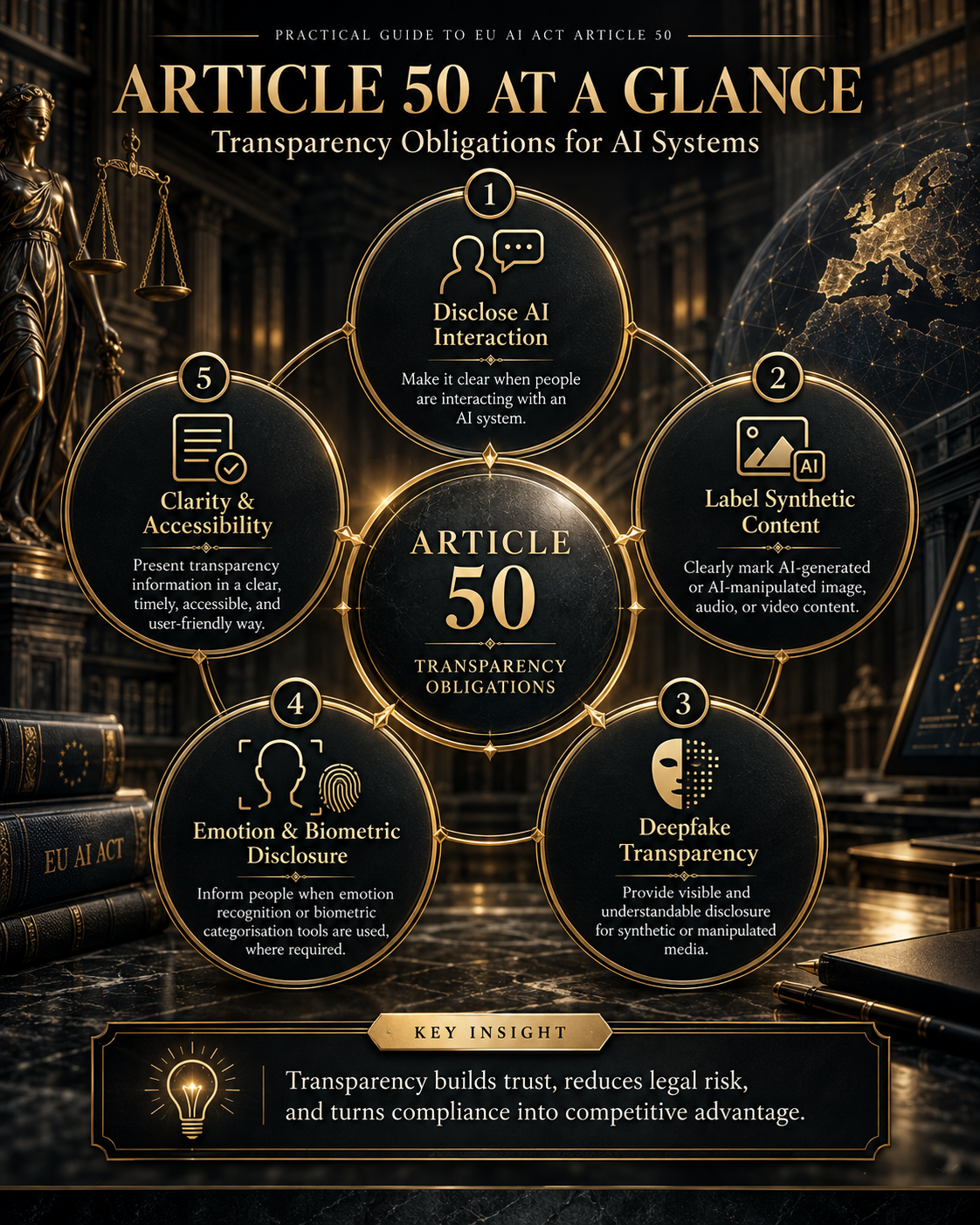
Article 50 introduces transparency obligations relating to several important areas of AI use.
The book explores these obligations through five practical themes:
01 — DISCLOSE AI INTERACTION
People should be informed when they are interacting with an AI system where the regulation requires such disclosure.
02 — LABEL SYNTHETIC CONTENT
Certain AI-generated or AI-manipulated content may require appropriate identification or marking.
03 — DEEPFAKE TRANSPARENCY
Synthetic or manipulated image, audio, or video content may require visible and understandable disclosure.
04 — EMOTION & BIOMETRIC DISCLOSURE
Where relevant transparency obligations apply, people should understand when emotion recognition or biometric categorisation technologies are being used.
05 — CLARITY & ACCESSIBILITY
Transparency information should be presented in a clear, distinguishable, accessible, and understandable way.
FROM COMPLIANCE TO COMPETITIVE ADVANTAGE
Transparency should not be seen only as a regulatory obligation.
Handled well, it can strengthen:
TRUST
People understand when and how AI is being used.
GOVERNANCE
Organisations know who is responsible for transparency decisions.
CONSISTENCY
Teams apply common principles instead of improvising.
RISK MANAGEMENT
Potential misunderstandings and compliance gaps can be identified earlier.
CUSTOMER CONFIDENCE
Clear communication makes AI use easier to understand and accept.
ORGANISATIONAL MATURITY
Transparency becomes part of the way AI systems are designed, deployed, and managed.
The central idea of the book is simple:
Transparency can become part of good AI strategy, not merely a compliance exercise.
WHO THE BOOK IS FOR
The guide is designed for people who need to understand Article 50 without becoming specialists in every part of European AI regulation.
It is particularly relevant for:
Business leaders
Boards and executive teams
AI programme leaders
Compliance professionals
Legal teams
Risk and governance teams
Product managers
Technology teams
Marketing and communication teams
Public-sector organisations
Healthcare organisations
Financial institutions
Universities and educational organisations
Consultants and advisors
AI developers and deployers
Policy professionals
WHAT YOU WILL FIND INSIDE
The book brings together:
Plain-language explanations
Structured interpretation
Practical implementation guidance
Visual frameworks
Decision models
Governance considerations
Transparency examples
Organisational questions
Implementation checklists
Risk considerations
Communication principles
Real-world application scenarios
The objective is not simply to explain the law.
The objective is to help readers understand:
What does this mean?
Why does it matter?
Where could it apply?
Who should be involved?
What should we do next?
A PRACTICAL APPROACH
The book follows a simple progression:
UNDERSTAND → INTERPRET → MAP → DESIGN → IMPLEMENT → REVIEW
UNDERSTAND
Understand the transparency obligation.
INTERPRET
Determine what the requirement means in practical terms.
MAP
Identify relevant systems, processes, people, and situations.
DESIGN
Create appropriate transparency mechanisms.
IMPLEMENT
Integrate them into real operations.
REVIEW
Monitor whether the approach remains clear, appropriate, and effective.
MORE THAN A LEGAL GUIDE
The Practical Guide to EU AI Act Article 50 sits at the intersection of:
LAW
What the regulation requires.
TECHNOLOGY
How AI systems actually operate.
GOVERNANCE
How organisations assign responsibility.
COMMUNICATION
How transparency is presented to people.
BUSINESS
How responsible AI supports trust and sustainable adoption.
PEOPLE
How individuals experience AI systems in practice.
This combination is essential because AI transparency is not only a legal matter.
It is also a design, communication, governance, and trust challenge.
THE PRINCIPLE BEHIND THE BOOK
A transparency notice can technically exist and still fail.
It can be:
too vague
too complicated
too hidden
too late
too legalistic
or simply too difficult to understand.
The real objective is therefore not merely disclosure.
The objective is meaningful transparency.
People should be able to understand what matters at the moment when it matters.
BUILT FOR PRACTICAL USE
The book can be read from beginning to end.
It can also be used as a working reference.
Different readers may use it differently:
Executives may focus on strategic implications.
Legal and compliance teams may focus on obligations and governance.
AI teams may focus on implementation.
Communication teams may focus on disclosure and clarity.
Boards may focus on risk, accountability, and oversight.
Educators and advisors may use the frameworks to explain Article 50 to others.
KNOWLEDGE BUILT TO LAST
AI regulation will continue to evolve.
Technology will continue to change.
Implementation practices will mature.
The enduring principle remains:
People deserve to understand when AI meaningfully affects their experience.
The purpose of this guide is to help organisations translate that principle into responsible practice.
PRACTICAL GUIDE TO EU AI ACT ARTICLE 50
“Transparency should not be seen only as a regulatory obligation.”
Kris Tremmery
Strategic Architect · Author · Advisor
Aeternum House
Knowledge built to last.
Transparency is not merely something an organisation communicates.
It is something an organisation designs into the way AI is governed, deployed, and experienced.

GO FURTHER
Continue exploring the publication.